Showing posts with label Leadership. Show all posts

Friday, May 26, 2023

Who moved my proxy?

On my morning walk I listened to Seth Godin on Tim Ferris's latest episode on his podcast. When Seth talks (or blogs), there is a nugget of advice in nearly every sentence and this podcast was no different. However, what stuck to me was the discussion around "false proxy". 

Proxies are something that are easier to measure and a close approximation to something that is hard to measure (Ex: Weight/BMI as a measure of health, using ranking as a proxy to decide to buy a book, using reviews as a proxy to select a good restaurant etc.,). While they all make sense, it could become a problem if we elevate the proxy and get obsessed with making the proxy look good and completely forgetting to improve the real thing we wanted to improve.

I could clearly see a lot of false proxies all around:

  • Processes that have been degenerated by measuring things that won't make any meaningful difference to the org or the customer the org is serving.
  • Continuations of certain roles which are no more relevant, but makes one feel good about something just because the role exists
  • Bureaucratic/centralized controls that stifle creativity and pace but makes someone creating such things to feel good
  • Measuring cost over value
  • Various employee engagement surveys that someone believes will give an accurate picture of what people feel in the trenches
  • Meetings and more meetings to measure progress

Many of these will start with all good intentions, but usually outlive their relevance and gets continued only because someone can feel important and have a sense of contribution. 

Even at a personal level it is easy to fall into the trap of measuring what's easy to measure and forget the core reasons of our being:
  • Expensive gifts as a proxy to show love
  • Expensive exercising gadgets to believe we are progressing toward our health goals
  • #books read as a proxy to knowledge/wisdom
  • #meetings attended/set-up as a proxy to productivity

What are some of the proxies you are stuck with? If you have come out of them, how did you do that?

Saturday, May 29, 2021

Type of task and the effort needed

 Often times we spend disproportionate amount of time on tasks that are non-value adding (wordsmithing a trivial mail, getting to precise numbers accurate to 2nd or 3rd decimal when a whole number would just do, take attention to detail to extremes on marginal tasks etc.,). Opposite is also true - that we spend very little time on high impact tasks (create shabby slide decks, convey incorrect/ambiguous data, forget target audience etc.,), most often due to lack of time (perhaps coming in from lack of prioritising). Heck, most of the times, we may not even be aware of relative impact of the task on hand to even apply some heuristic to decide how much effort to spend or what constitutes 'good enough'.

I found the following model very simple, actionable and profound (courtesy @shreyas).


Are you spending enough time on tasks that has high leverage?

Wednesday, January 27, 2021

Customers First and Systems Thinking

 A loved one was in hospital for better part of last 5-6 weeks. I got to observe many things having spent most of my time as primary attendant. This is one of the better known hospitals and does indeed have an impressive mission statement that aims to put the customer (patient in this case) first. Doctors are very good, nursing staff excellent, administrative staff are very helpful, so are the lowest rung of staff. 

One problem is that each set works within their own framework:

  • No one knows what time does the Doctor would come for rounds. When they come, and they definitely come, they are very patient, answer all the questions etc., Because they can't or don''t want to stick to a committed time, planning things become difficult. 
  • Due to specialisation, it is very common to hear "my part is fine, you need to check with X for that other problem". At one time there were 4 specialists taking care, but I wondered whether they talk and co-ordinate amongst themselves. Hope they were, but it wasn't apparent.
  • Nursing staff have their own pre-defined timetable to check vitals, draw blood, give medication etc., It doesn't matter to them whether the patient has just slept, or having some pain or need something else etc., I have to plead with them to come some 30mins later as my loved one might be fast asleep having completely missed the sleep the previous night! Ofcourse they are understaffed and it becomes difficult during weekend and holidays. 
  • Billing, Insurance and other admin related are in their own world. It takes about 7-8hrs from the time the Doctor approves discharge for the patient to get home. They need to complete billing etc., write a lengthy discharge summary, send it to insurance company and they have to approve etc.,
  • Insurance companies do not go over the bill incrementally say once every 2-3 days or so, even if they are all available. Everything has to happen on the day of discharge. 
  • I met with the PRO (yes they have one) and gave him multiple suggestions. Guess his job is to only say "great suggestion sir, I'll see how best I can implement" and really not worry about it.

While each actor is doing fine within their own specialisation, no one seem to care about how the system as a whole is working and how does it affect the customers (patients and attenders).

No need to pick just on hospitals. We see such a thing happening in best of the organisations. Every group thinks that they are indeed doing well and perhaps are when looked from a narrow angle of their own department. However the overall result may not be satisfactory. 

Many organisations want to put their customers first, respond to customer's needs, be customer centric etc., etc., But when the goal/intent gets trickled down the systems perspective gets lost. Someone at the top cannot fix it. It calls for every person in the chain to see whether their actions are in line what the CEO wants to achieve and whether they can be open to let go of their "authority" for the greater good of customer. 

Thursday, August 6, 2020

Naval's Jewels

I found myself frequently referring people to works of Naval Ravikant. I thought I will put all my recommendations in a post here.

Twitter: 

Web sites: 

Popular podcasts and fireside chats: 

Interesting articles:

Shameless plug-in: My post on my 60d meditation streak (interesting more for copy-paste of Naval's tweetstorm on meditation)

Sunday, May 24, 2020

6 Lessons from Tobi Lutke, CEO of Shopify

Twitterati @george__mack recently sent out a tweet storm summarising the lessons he learnt from listening to several podcasts of Tobe Lutke - CEO of Shopify. I'm copy-pasting them so that it is available readily.

LUTKE LEARNING 1 - OPERATE ON CROCKERS LAW

Crocker is a Wikipedia editor who asked people to NEVER apologise about editing his pages. He just wanted them to focus on making his pages BETTER.

He took 100% responsibility for his mental state. If he was offended, it's his fault.
"Just give me the raw feedback without all the shit sandwich around it." - Tobi

"Feedback is a gift. It clearly is. It’s not meant to hurt. It’s meant to move things forward, to demystify something for you. I want frank feedback from everyone." - Tobi
"If I'm insulted it's because my brain made a decision, to implant in my memory and thoughts the idea of being insulted by that person...

I did that under my own volition. It was my own choice. My brain has assigned the power to the other person" - Tobi referencing Aurelius

LUTKE LEARNING 2 - ALWAYS BE A STUDENT TO FIRST PRINCIPLES

Tobi's most consistent used mental model throughout his interviews is:

Global Maximum > Local Maximum

Local Maximum = Optimising a cog in the machine
Global Maximum = Optimising the machine itself
Tobi's favorite example of FIRST PRINCIPLES is a Truck driver.

His truck was sat still for 8 HOURS on THANKSGIVING waiting for his cargo to be unloaded when he realized... "Why not take the WHOLE trailer off the back of my ship rather than unloading + reloading each item?" This Truck driver was called Malcolm McLean

His first principles approach created the SHIPPING CONTAINER. The results?  Global shipping costs went from $6 a tonne to $0.16 a tonne 🤯

The most underrated entrepreneur of the last century AND the godfather of modern global trade.

Tobi seems to try to operate under the assumption that everything he is doing could be WRONG. "I think the best company (that exists right now) is a 6/10 on the scale to what is a perfect company" - Tobi

His goal is to get near a 6/10 and push towards a 7/10.  Humanity's most consistent fallacy is assuming the present moment has it figured out. We look back and laugh at our assumptions from 50 years ago. Whilst simultaneously forgetting that 50 years from now they be will be laughing at us. 

LUTKE LESSON 3 - THINK ABOUT THE LONG TERM

The media narrative is often a dichotomy of Shopify vs Amazon. Few talk about the similarity both CEO's have for LONG TERM thinking. Both consistently warn shareholders that they will sacrifice short term revenue for long term value.

Tobi states that almost EVERY DECISION your business makes can pivot on JUST one question:
"Are you optimizing for every individual transaction or the LIFETIME transaction?" - Tobi

Are you playing INFINITE games or FINITE games with your customers? Growth Marketers would tell Shopify to force "Powered By Shopify" branding on their Merchants stores. Everyone who then visits the stores would then know Shopify builds stores like these.

This is the sort of "Growth Loop" that VC's dream of. Shopify DIDN'T DO this.
“We want to make other people look good. We want to make merchants look good." - Tobi (2017 AMA)

Lutke calls this "LTV thinking" in his interview with @garyvee

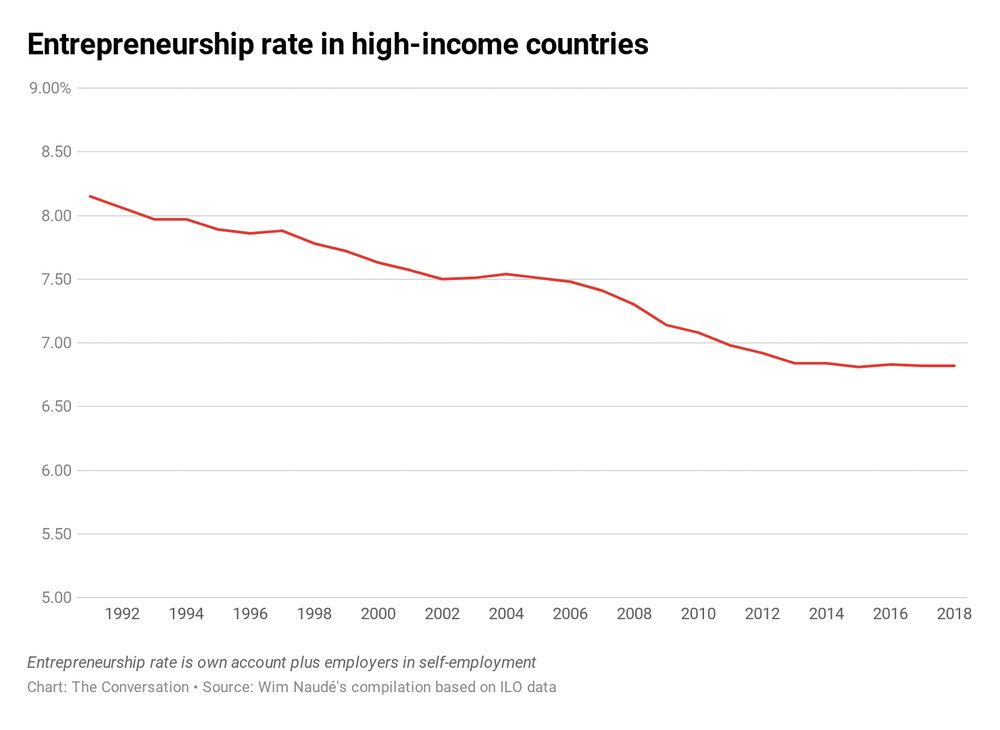
On a long enough timeline, playing positive-sum games with your customers is the ultimate growth hack. It's hard to find a more positive-sum company. There are few (legal) highs that compete with the "1st Shopify Sale Moment". Every 60 SECONDS somebody makes their 1st sale on Shopify 🤯

They are trying to help reverse this graph by reducing the friction of entrepreneurship
LUTKE LEARNING 4 - EMBRACE TRANSFER LEARNING

"Video games are very distilled environments in which you can learn things." - Tobi
He believes that playing certain games can help your brain rehearse thousand of repetitions for situations that are scarce in the real world. In the business world, you might make a strategic bet every year.

It may take you 10 years to get the experience of strategic 10 bets.In the poker world, you make a strategic bet every hand. It takes you less than one evening to get the experience of 10 strategic bets. "I'm a card-carrying member of the video games are really good club" - Tobi

"Every employee at Shopify can expense Factorio" - Tobi on one of his favorite games. He sees the mental effects of playing Factorio as a worthwhile business expense for his company

LUTKE LEARNING 5 - DECISION MAKING

"Every single time I got a decision wrong, I realised that the piece of information that was missing was actually in fact totally available to me." - Tobi

“We tend to underestimate how difficult it was to make a decision in hindsight” - Tobi
"If your job is to make decisions, it’s worth treating it like any other subject to get better at." - Tobi Whenever he makes a decision, he keeps a small log file with one paragraph explaining what information he used to make that decision. He reviews it every 6 months
Kasparov had a "SYSTEMS MINDSET" for analyzing his chess mistakes, e.g. Pawn to E4 lost the game

Outcome mindset = "Don't do Pawn to E4 again".

Systems mindset = "What was the mental routines that occurred before I made that decision? Don't do them again"
OUTCOME MINDSET prevents you from making that ONE mistake again.

SYSTEMS MINDSET prevents you from using the mental models that caused that mistake.

SYTEMS MINDSET prevents that one mistake AND 100's of other potential mistakes by addressing the root cause.

H/T @SafiBahcall
LUTKE LEARNING 6 - TALENT STACK LED BY CURIOSITY > MBA

He didn't have an MBA. He didn't grind 100-hour workweeks.

Instead, he played video games (which led to coding) and he snowboarded (which led to an online snowboarding store). This 'Talent Stack' led to Shopify.
"Following your genuine intellectual curiosity is a better foundation for a career than following whatever is making money right now." - @naval

Pursuing your unique talent stack and curiosity is often inversely correlated with appearing successful early on.

Stop caring.
TOBI'S FAVOURITE BOOKS:

- 'Courage To Be Disliked' by Kishimi

- 'High Output Management' by Grove

- 'The Box' by Levinson

- 'Thinking In Systems' by Meadows

- 'Meditations' by Aurelius

- 'Guide To The Good Life' by Irvine

(Don't forget Factorio and Starcraft!)


Friday, December 13, 2019

Great podcasts to end the year

Breaker.audio (@breaker) recently published Top 100 Hot Podcasts of 2019. It has some great podcasts. I've listed a few here - mostly on leadership and self-development. 

Some of these are pretty long (>60mins), but it is very difficult to put them off once you start listening to them. Its a great way to learn new things when we are commuting.

  • Deep work: We haven't admitted the true cost of interruptions. In this conversation with computer scientist Cal Newport talks about shutting down distractions and focus on meaningful work.
  • Interview with Jim Collins: This is one of the rare interviews with reclusive author of Built to Last and Good to Great. He talks about leadership, how he manages his time (the 50:30:20 concept, 20 mile march, etc.,
  • How to get rich - by @naval: Naval talks about concepts like - Seek Wealth, Not Money or Status, Make Abundance for the World, Make Luck Your Destiny, Pick Partners With Intelligence, Energy and Integrity, Read What You Love Until You Love to Read, Judgment Is the Decisive Skill, Eventually You Will Get What You Deserve, There Are No Get Rich Quick Schemes
  • Lessons from a Trillion-Dollar Coach - Eric Schmidt. Eric talks about a wide range of things, including about the book Trillion-Dollar Coach, which is a book about Bill Campbell, who helped to build some of Silicon Valley’s greatest companies—including Google, Apple, and Intuit—and to create over a trillion dollars in market value. A former college football player and coach, Bill mentored visionaries such as Steve Jobs, Larry Page, and Eric Schmidt, and coached dozens of leaders on both coasts.
  • Keeping the Flywheel in Motion - Jim CollinsThe Flywheel effect is a concept developed in the book Good to Great. No matter how dramatic the end result, good-to-great transformations never happen in one fell swoop. In building a great company or social sector enterprise, there is no single defining action, no grand program, no one killer innovation, no solitary lucky break, no miracle moment. Rather, the process resembles relentlessly pushing a giant, heavy flywheel, turn upon turn, building momentum until a point of breakthrough, and beyond.

Friday, December 6, 2019

Learning by Observing

We all learn in different ways (BTW, do you know how you learn?), and mine is by reading and observation (specifically observing leaders that I admire). One of the things I practice is to observe how leaders run the Q&A part in a townhall/allhands meeting. When someone asks a question in, I try to see how I’d answer the same and then compare with the answer the leader gave and check the difference. In most cases, I’d have given out the same content, but the difference lies in sequencing, choice of words, tailoring to the audience, maintaining composure etc., I’ve learnt quite a lot this way and continue to learn. Do try it out next time, I’m sure you’d learn something. 

Yesterday, I got an opportunity to learn from a senior leader. I know this leader ever since I joined National Instruments. He taught me our standard leadership course during my first year and his class inspired me to become a facilitator myself. In yesterday's class I noticed the following:

  • He was not rushing to answer. He took time to phrase it correctly (couple of times he did tell that he is thinking on how to put it concisely). It was a very tricky meeting in that one or two incorrectly phrased sentences or wrong choice of words had a potential to create unwanted confusion.
  • He was repeating the questions or rephrasing it (particularly when people meandered with their questions) before answering. This (repeating the question) is a great technique in that it helps in multiple ways:
    • It helps others also to understand the question correctly. Specifically important in conference calls involving many sites
    • It makes sure that we have correctly understood the question and gives us a choice to correct ourselves if we have misunderstood the question and started on a lengthy sermon for a question that was not asked
    • It allows us time to frame the answer (common mistake many of us make is to start framing the answer before we completely hear the question)
    • In few cases it also helps the questioner to get clarity and actually get what they exactly wanted to. We saw examples of these through the Q&A


  • He kept an eye on the time, but we didn't get an impression that he was rushing 
  • His answers were very precise. He didn’t disclose anything he was not supposed to. Didn't make any commitments he could not have made. He was open in admitting he cannot give the answer or do not have the answer. He also said why he’d not disclose the answer
  • He was humble to acknowledge things he was not aware of 
  • He did a great job in representing the corporate, was very respectful about the sites and local issues
  • Frequently he was drawing the senior folks of the site to bring in local examples.


  • Above all, the preparation was important too:
    • He came to the stage about 30mins before the scheduled talk, made sure his laptop, mic etc., were all working. This allowed him to be in a relaxed frame of mind when the meeting actually started
    • He had a printout of the slides and had made some notes in it and was frequently checking the notes to make sure he didn’t miss anything. 
    • He had a print out of the questions that came in email and that helped him to answer them all without having to rely on the memory
    • He also had a print out of the FAQ, he glanced at it again and made sure everything was covered.
    • Knowing this leader I’m sure he’d have rehearsed it multiple times

Do not discard these as they seem like little things. These seemingly small little things are the ones that would add up. Afterall, excellence is doing ordinary things in an extraordinary way. 

Love to hear other things you might have observed.


Wednesday, November 13, 2019

25 Principles of Adult Behaviour

Chanced upon this gem by John Barlow. Difficult to follow all of them all of the time. Still worthwhile to go over it regularly and re-orient our compass where needed. Backstory on this here.


Wednesday, October 30, 2019

Rules vs Principles

My first job was with a company (now called Sasken) that had only 20+ employees when I joined and I  witnessed it grew to 1000+ over the next 10 years. Being one of the early employees, I had a great opportunity to participate in framing the policies as the company grew from a "start-up" to an established one. I had a great fortune of learning directly from the founders and some very senior executives on building and sustaining culture, governance, ethical behaviour at all times and I've been able to use these learning later in my career when I built teams from ground-up and even running large teams in established MNCs.

One of the key learning of those early days was the striving to make decisions based on "principles". Infact, one of the apt repeated question was "what is the principle behind it?". Sticking to principles removes any biases one might have towards a particular person or an idea. I continue to ask this question when we struggle to make a decision or there are multiple competing choices - each favouring one or the other aspect. Once the discussion moves from this vs that to agreeing on a principle, the natural decision or the outcome becomes clear and obvious.

I also frequently run into folks that act as bureaucrats (one definition that I like is "a bureaucrat is a person that believes his job is to say NO"). They'd be very well and perfectly operating within the rules and seem to believe they are doing as expected and getting needlessly blamed. Such people do not bother about the spirit, but really go with the letter. Principles are "spirit", Rules are "letter". How to spot them? These people:
- add more non-value adding work to colleagues
- have their first instinct to usually deflect the work to someone else citing the (correct) rules
- cannot (or do not want to) distinguish between routine vs emergency
- are pretty good in telling everyone "not my job" (and they'd still be right)
- do not understand the concept of (internal) customer or more precisely
- are quick to escalate "deviations" by other colleagues who might be bending the rules, but operating within the principles
- do not understand the concept of being of "service" to someone
- insist on sticking to "rules" even when rest of the world agrees it is stupid to do so.

etc., etc., (all these while strictly being within the rules)

Now how do we deal with such people?

There are some standard ways - provide direct feedback in STAR/STAR-AR format detailing how such an attitude is creating problems, talk to the person's manager and seek help, provide formal feedback via survey offer to mentor etc.,

However if you are in a leadership position and such behaviour is counter-culture, one cannot escape responsibility from setting it right. Remember culture is not a set of beliefs, but a set of actions. When not corrected quickly the org can quickly degenerate into a huge bureaucracy.

I'm not suggesting we bend rules all the time. If we can do justice to both letter and spirit it is great. However, sticking to rules for the sake of it and at the cost of principle is grossly incorrect - foolish consistency is the hobgoblin of little minds, said the great Ralph Waldo Emerson.

Next time when you instinctively say NO or quote some rule, think whether you are acting from principles or against it.

Thursday, September 26, 2019

Naval Ravikanth on Work Hacks he has devised

Found these thoughts by Naval Ravikanth (@naval) very interesting.

  • No meetings before 11am. 
  • No meetings when emails or calls will do. 
  • Don’t schedule calls, text coordinate them on the fly when possible. 
  • Cram all meetings into two days a week. 
  • 1-on-1s are usually 30-minute walking meetings. (Meetings are the death of productivity)
  • Delete emails w/o responding or flinching. 
  • Don’t set up voicemail. 
  • Don’t travel purely for business. 
  • Don’t go to conferences unless speaking. 
  • Eat dinner with friends or family. 
  • Use blocks of open time to create, make good decisions, & focus on important over urgent.

Saturday, September 14, 2019

On Giving and Receiving Feedback

I'm preparing to give a brown bag talk on "Receiving Feedback: How to resist the urge to tell "I'm Right; You're Wrong". As a part of preparation I did literature survey on HBR articles, courses available etc on the subject. Just thought of making it all available in one place. I've also added a few books that has helped me act on the feedback I received.

HBR Articles:


Courses:

Books (not directly on Feedback, but the ones that has helped me to apply the feedback):


Tuesday, September 10, 2019

Converting Potential to Success: Actionable Tools

I ran into this very interesting HBR article titled "Turning High-Potentials into Success: The missing link in leadership development". 

The article talks of a process the authors have successfully deployed. Two things captured my attention and that can be used immediately to develop ourselves and also our team:
  • They have identified 4 traits that are hallmarks of potential according to another research and these are 1. Curiosity (a penchant for seeking out new experiences, knowledge, and candid feedback and an openness to learning and change), 2. Insight (the ability to gather and make sense of information that suggests new possibilities), 3. Engagement (a knack for using emotion and logic to communicate a persuasive vision and connect with people) and 4. Determination (the wherewithal to fight for difficult goals despite challenges and to bounce back from adversity)
  • They also have identified eight competencies that we believe are crucial for: results orientation, strategic orientation, collaboration and influence, team leadership, developing organizational capabilities, change leadership, market understanding and inclusiveness.
The best part though is that they have talked about seven levels for each of the competencies and tell which of the four traits are required to excel in a given competency. Check the table below:


This is a very useful table in many ways:
1. We can use it to assess where we are seek help to get to next level
2. Use the same to have engagement conversation with team members in a more structured way
3. Possibly set levels for each competency for each title and help people progress.

Do let me know if you use it or have any insights on how else this could be used. 

Saturday, July 20, 2019

Are you chasing mice or hunting an antelope?

Found this analogy very powerful:

Here's a brilliant illustration to explain the need to focus on the big things and let the little stuff slide: the analogy of the field mice and the antelope. A lion is fully capable of capturing, killing, and eating a field mouse. But it turns out that the energy required to do so exceeds the caloric content of the mouse itself. So a lion that spent its day hunting and eating field mice would slowly starve to death. A lion can’t live on field mice. A lion needs antelope. Antelope are big animals. They take more speed and strength to capture and kill, and once killed, they provide a feast for the lion and her pride. A lion can live a long and happy life on a diet of antelope. The distinction is important. Are you spending all your time and exhausting all your energy catching field mice? In the short term it might give you a nice, rewarding feeling. But in the long run you’re going to die.

So ask yourself at the end of each day "Did I spend today chasing mice or hunting antelope"

(taken from the book: Buck up, Suck Up ...... and Come back when you Foul Up: 12 Winning Secrets From The War Room)


Monday, July 1, 2019

How do you contribute?

Leaders as servant of their followers is a powerful and proven concept (The book Servant Leadershipemphasizes this concept very well). Many leaders at NI has embodied this principle very well (Kevin Schultz repeatedly tells “remember, I work for you”). While it is easy to grasp this concept intellectually, putting into practice might need some actions that are not straight forward. 

The picture below shows many different ways one can contribute (in general). It is important to know how to apply our strengths and how we can contribute to a person/team/situation.


Sunday, May 26, 2019

Notes from Astronaut Scott Kelly's keynote at NI-Week 2019

I had the good fortune of listening to Astronaut Scott Kelly who delivered closing keynote at NIWeek2019. The talk was so good that most senior leaders of NI that I met later (including Scott Rust) asked did I attend Kelly’s talk. I had taken some notes as he spoke and thought I’ll try summarizing it as a part of this week’s BBL newsletter. It is not structured and comes in the same order as he spoke.

Scott Kelly has spent over 500 days in International Space Center, including a trip of nearly an year as a part of experiment that NASA was doing (what happens to human bodies in space when they spend an year or so as they prepare to send people to Mars someday). He has written a book called “Endurance” highlighting his journey.

  • He opened the talk with this quote
    • People do not decide to become extraordinary. They decide to do extraordinary things” – Edmund Hillary 
  • Mantra for success:
    • Set a goal, have a plan and put in hard work.
    • Focus on things I can control, take risks and not be afraid to fail.
    • Doing the above I’ve learnt sky is not the limit
  • Childhood
    • Was average in school. Could not focus on anything for long. In this era, I’d have been classified as having ADHD. Never thought being Astronaut is possible. 
    • Initial and profound inspiration was my mother, who decided to become the first female police officer of their state. My dad set-up a 8ft wall for her to practice to climb and jump to the other side – one of the tough physical test as a part of admission test.
    • My mother was 5.5ft and it was too much for her and no one thought she would be able do it. But she was determined and had a plan and pursued with all her might. She had broken the goal in to a series of small goals. First goal was just to jump and touch the top, and once this is done then the next goal was to hang on to it, and the next step was to do pull ups and the final step was to climb it and get over the wall.   
    • This was the first time I saw the power of goal, the need for a plan and the fruits of working hard to get there.
  • College
    • Continued to be an average student. Ended up going to the wrong college, as in went to “this” college thinking it is “that” college – perhaps only one in the country.
    • Life changing event when I read the book The Right Stuff – by Tom Wolfe. Changed the life as I figured out I’ve all the traits to become a fighter pilot, but didn’t know how to study!
    • Turned myself into good student, changed majors, graduated and joined Navy.
    • How we start has no bearing on what we can become – goal, plan, hard work”
    • Became a pilot, test pilot, and finally flew the F14-tomcat.
  • Professional
    • I failed with the first landing on the aircraft carrier and was sent back. Got options to fly bigger plane that lands on runway and not landing on ship, which would have permanently moved me away from being a fighter pilot, let alone be an Astronaut.
    • Spoke to a guide and mentor who pointed out that my learning has plateaued and I was no more making small and continuous improvement. Guide/Mentor also asked me to never get comfortable even when there are failures and said you’d eventually succeed.
    • I decided to take risk and asked for a re-test. Was able to land the F14 on the deck in both day and night and got inducted into Navy which paved the way to become an Astronaut eventually.

  • Message
    • Successful people’s trait: Ability to take risk, make mistakes and at times even willing to fail.
  • We also have to make things little better all the time. Never rest on laurels.
    • Compartmentalization – focus on things you can control, doing the job and ignoring everything else.
    • Greatest accomplishment is knowing that I’ve done the hardest thing I never thought I’d be able to do and be around to tell the story.
    • Teamwork. Spacework is a big team work, including team in ground. Anything complex can be achieved only by a team, though the person in the front might get all visibility etc. Always be a part of the team
    • Leadership - Depends on the situation. Use the option that makes the most sense for a situation -  Vote. Make decision. Dictator – decide and announce. Consensus etc.,
    • Diversity. Having diverse set is a strength.
    • Orbital perspective: Don’t see political borders. When looked from a higher perspective, there are people, problems etc., and nothing else. We are all humans.
    • If we can dream it, we can do it. If we plan, focus only on things we can control, appreciate teamwork and work hard….. Sky is NOT the limit.

There is no way I can make justice to the electrifying 60mins that just flew (“Good communication forces you to listen” – Max De Pree). I doubt whether he’d allow NI to put up his keynote in public. I’m checking around if it can be made available to just employees. In the mean time I searched youtube and you can see some videos here and here that covers most of the things he spoke (including the jokes). 


Sunday, March 17, 2019

Fixed vs Growth Mindsets

Who you are today is not who you have to be tomorrow.
And
Who your team member is today, is NOT the one tomorrow

I’ve been guilty of labelling myself “I’m this and not that” or “this comes to me naturally and I simply can’t do that” and have held myself back from exploring my fullest potential (as they say “YOU are your greatest enemy”). And the most dangerous thing for a leader apart from labelling self, is to label a team member this or that and not being open to possibilities.

In a fixed mindset, people believe their qualities are fixed traits and therefore cannot change. These people document their intelligence and talents rather than working to develop and improve them. They also believe that talent alone leads to success, and effort is not required.

Alternatively, in a growth mindset, people have an underlying belief that their learning and intelligence can grow with time and experience. When people believe they can get smarter, they realize that their effort has an effect on their success, so they put in extra time, leading to higher achievement.

Carol Dweck, a researcher at Stanford made the concept go viral in her pathbreaking book Mindset: How we can learn to fulfil our potential.

This concept is very very important for each individual to realize our own potential. And could make a difference between a good and a great leader. As a great leader our job is to move people from fixed to growth mindset whenever we see one. Please make time to read this book.

Reflection:
It was a tad late when I ran into this book. You are right, this is a wonderful book for parenting. My sons, both of them, somehow got this notion in their head, “I’m not good in Chemistry, OK in Math, Very good in programming” – a classic Fixed mindset. I’ve been trying hard to get them to understand that we can make incremental improvements in virtually any subject if we make consistent efforts and push the boundary. The book infact advises to NOT praise “inherent talent”, but to praise the “effort” when kids do well. It implores parents to put into every kids head to value effort over talent. I cannot recommend a better parenting book.

Sunday, March 3, 2019

How great leaders inspire action


Out of nowhere I remembered this fab TED talk by Simon Sinek where he talks how great leaders start from “Why”, but not from “What” and explores how leaders can inspire cooperation, trust and change. I strongly recommend going over the 18min talk that has 42M+ hits. If you like this, you may also want to read his classic  Start With Why: How Great Leaders Inspire Everyone to Take Action.

I also like the talk for the way it is presented and we can learn from it. When you are watching, keep an eye on:
  • How he uses the flip chart to explain the concept in simple terms
  • How he repeats the central point again and again
  • Subtle humor
  • Examples that everyone can relate to (Apple, Dr.MLK, Wright brothers etc.,)
  • Voice modulation

RamP!

Sunday, February 17, 2019

Managing Emotions

Sitting close to Kevin Schultz means having an opportunity to talk to him regularly, apart from weekly 1-1s. Y’day he generally dropped by my cube to see how I was doing and somewhere discussion turned to range of emotions one display as a leader. He drew this scale 

Anger -> Disappointment -> No Response -> Agreement -> Joy

He says that there could be situations that a leader has to get angry and actually show it. However, it should be kept at minimum. He says “disappointment” must be used more frequently when things don’t go well. “No Response” is kind of an indifference – where an approach chosen or a decision made by a team member may not cause a big problem, but the person might not have “got it”, so you react by being indifferent.

I thought I’ll share this.

Do note that I’ve seen many people using “this person doesn’t “get it””. This is a dangerous position to be in. It is expected, atleast dealing with senior people, that you are in a position to assess what exactly the senior person wants even when the instructions may not be detailed. It can even be simple things like not using standard company template for ppt, put one gets labeled as not-getting-it. This is where self-awareness comes-in.

Changing the topic. The article titled “No, You Can’t Ignore Email. It’s Rude” by Adam Grant is going viral. The author argues that Being overwhelmed is no excuse. It’s hard to be good at your job if you’re bad at responding to people and says “Everyone occasionally misses an email. But if you’re habitually “too busy” to answer legitimate emails, there’s a problem with your process. It sends a signal that you’re disorganized — or that you just don’t care”.


Sunday, February 3, 2019

Why bad leaders focus on being friends first


Interesting article.

I’ve always disliked leaders that sugar coat feedback and/or exaggerate accomplishments of the team members when there is none or at best mediocre. This might be fine in the short run (people will “like” such leaders better than someone that is seen demanding/challenging), but in the long run everyone finds out resulting in a trust deficit. Of course it doesn’t mean one should not focus on friendship or friendly leader aren’t effective. Colin Powell said “Being responsible means sometimes pissing off people” in his celebrated principles of leadership

I also have made a my fair share of mistakes of being “too much people focussed” and therefore not able to make good business decisions which would be long term (and win-win).

Ofcourse no one likes constructive feedback (though we publicly proclaim that we actually receive less feedback and welcome more), but in the long run we need our leaders to challenge us and help us grow. And for that to happen we have to be open for constructive feedback. Focussing on being “liked” is a big impediment. When we expect this from our leaders, why not provide the same for people that have given us an opportunity to lead them.