Showing posts with label Excellence. Show all posts

Wednesday, January 27, 2021

Customers First and Systems Thinking

 A loved one was in hospital for better part of last 5-6 weeks. I got to observe many things having spent most of my time as primary attendant. This is one of the better known hospitals and does indeed have an impressive mission statement that aims to put the customer (patient in this case) first. Doctors are very good, nursing staff excellent, administrative staff are very helpful, so are the lowest rung of staff. 

One problem is that each set works within their own framework:

  • No one knows what time does the Doctor would come for rounds. When they come, and they definitely come, they are very patient, answer all the questions etc., Because they can't or don''t want to stick to a committed time, planning things become difficult. 
  • Due to specialisation, it is very common to hear "my part is fine, you need to check with X for that other problem". At one time there were 4 specialists taking care, but I wondered whether they talk and co-ordinate amongst themselves. Hope they were, but it wasn't apparent.
  • Nursing staff have their own pre-defined timetable to check vitals, draw blood, give medication etc., It doesn't matter to them whether the patient has just slept, or having some pain or need something else etc., I have to plead with them to come some 30mins later as my loved one might be fast asleep having completely missed the sleep the previous night! Ofcourse they are understaffed and it becomes difficult during weekend and holidays. 
  • Billing, Insurance and other admin related are in their own world. It takes about 7-8hrs from the time the Doctor approves discharge for the patient to get home. They need to complete billing etc., write a lengthy discharge summary, send it to insurance company and they have to approve etc.,
  • Insurance companies do not go over the bill incrementally say once every 2-3 days or so, even if they are all available. Everything has to happen on the day of discharge. 
  • I met with the PRO (yes they have one) and gave him multiple suggestions. Guess his job is to only say "great suggestion sir, I'll see how best I can implement" and really not worry about it.

While each actor is doing fine within their own specialisation, no one seem to care about how the system as a whole is working and how does it affect the customers (patients and attenders).

No need to pick just on hospitals. We see such a thing happening in best of the organisations. Every group thinks that they are indeed doing well and perhaps are when looked from a narrow angle of their own department. However the overall result may not be satisfactory. 

Many organisations want to put their customers first, respond to customer's needs, be customer centric etc., etc., But when the goal/intent gets trickled down the systems perspective gets lost. Someone at the top cannot fix it. It calls for every person in the chain to see whether their actions are in line what the CEO wants to achieve and whether they can be open to let go of their "authority" for the greater good of customer. 

Thursday, August 6, 2020

Naval's Jewels

I found myself frequently referring people to works of Naval Ravikant. I thought I will put all my recommendations in a post here.

Twitter: 

Web sites: 

Popular podcasts and fireside chats: 

Interesting articles:

Shameless plug-in: My post on my 60d meditation streak (interesting more for copy-paste of Naval's tweetstorm on meditation)

Sunday, May 24, 2020

6 Lessons from Tobi Lutke, CEO of Shopify

Twitterati @george__mack recently sent out a tweet storm summarising the lessons he learnt from listening to several podcasts of Tobe Lutke - CEO of Shopify. I'm copy-pasting them so that it is available readily.

LUTKE LEARNING 1 - OPERATE ON CROCKERS LAW

Crocker is a Wikipedia editor who asked people to NEVER apologise about editing his pages. He just wanted them to focus on making his pages BETTER.

He took 100% responsibility for his mental state. If he was offended, it's his fault.
"Just give me the raw feedback without all the shit sandwich around it." - Tobi

"Feedback is a gift. It clearly is. It’s not meant to hurt. It’s meant to move things forward, to demystify something for you. I want frank feedback from everyone." - Tobi
"If I'm insulted it's because my brain made a decision, to implant in my memory and thoughts the idea of being insulted by that person...

I did that under my own volition. It was my own choice. My brain has assigned the power to the other person" - Tobi referencing Aurelius

LUTKE LEARNING 2 - ALWAYS BE A STUDENT TO FIRST PRINCIPLES

Tobi's most consistent used mental model throughout his interviews is:

Global Maximum > Local Maximum

Local Maximum = Optimising a cog in the machine
Global Maximum = Optimising the machine itself
Tobi's favorite example of FIRST PRINCIPLES is a Truck driver.

His truck was sat still for 8 HOURS on THANKSGIVING waiting for his cargo to be unloaded when he realized... "Why not take the WHOLE trailer off the back of my ship rather than unloading + reloading each item?" This Truck driver was called Malcolm McLean

His first principles approach created the SHIPPING CONTAINER. The results?  Global shipping costs went from $6 a tonne to $0.16 a tonne 🤯

The most underrated entrepreneur of the last century AND the godfather of modern global trade.

Tobi seems to try to operate under the assumption that everything he is doing could be WRONG. "I think the best company (that exists right now) is a 6/10 on the scale to what is a perfect company" - Tobi

His goal is to get near a 6/10 and push towards a 7/10.  Humanity's most consistent fallacy is assuming the present moment has it figured out. We look back and laugh at our assumptions from 50 years ago. Whilst simultaneously forgetting that 50 years from now they be will be laughing at us. 

LUTKE LESSON 3 - THINK ABOUT THE LONG TERM

The media narrative is often a dichotomy of Shopify vs Amazon. Few talk about the similarity both CEO's have for LONG TERM thinking. Both consistently warn shareholders that they will sacrifice short term revenue for long term value.

Tobi states that almost EVERY DECISION your business makes can pivot on JUST one question:
"Are you optimizing for every individual transaction or the LIFETIME transaction?" - Tobi

Are you playing INFINITE games or FINITE games with your customers? Growth Marketers would tell Shopify to force "Powered By Shopify" branding on their Merchants stores. Everyone who then visits the stores would then know Shopify builds stores like these.

This is the sort of "Growth Loop" that VC's dream of. Shopify DIDN'T DO this.
“We want to make other people look good. We want to make merchants look good." - Tobi (2017 AMA)

Lutke calls this "LTV thinking" in his interview with @garyvee

On a long enough timeline, playing positive-sum games with your customers is the ultimate growth hack. It's hard to find a more positive-sum company. There are few (legal) highs that compete with the "1st Shopify Sale Moment". Every 60 SECONDS somebody makes their 1st sale on Shopify 🤯

They are trying to help reverse this graph by reducing the friction of entrepreneurship
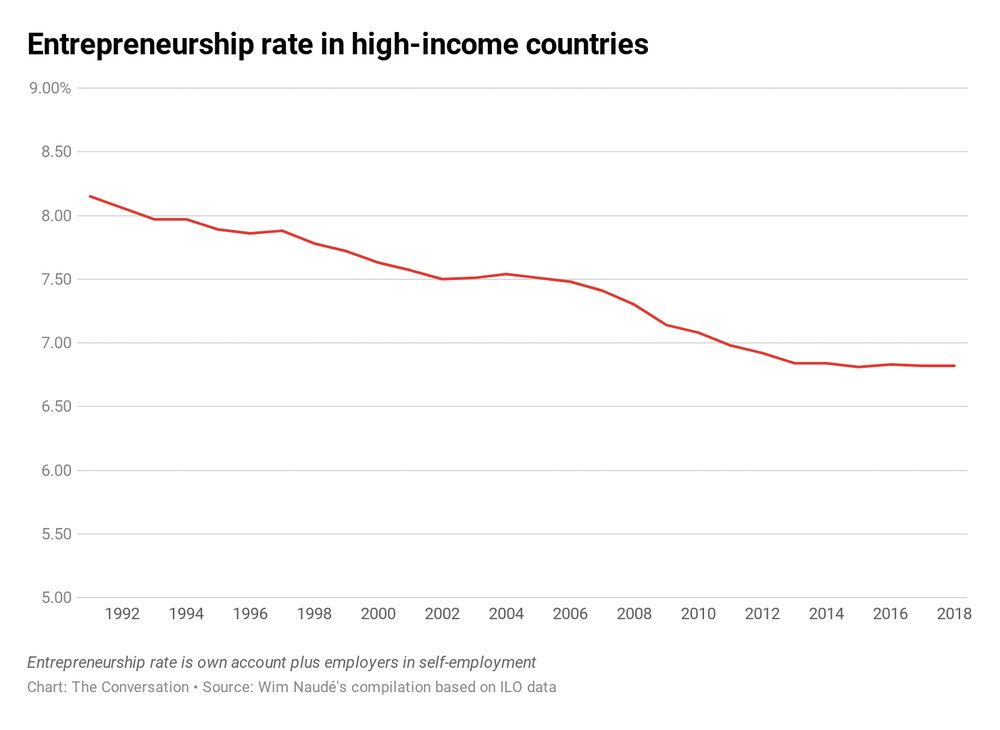
LUTKE LEARNING 4 - EMBRACE TRANSFER LEARNING

"Video games are very distilled environments in which you can learn things." - Tobi
He believes that playing certain games can help your brain rehearse thousand of repetitions for situations that are scarce in the real world. In the business world, you might make a strategic bet every year.

It may take you 10 years to get the experience of strategic 10 bets.In the poker world, you make a strategic bet every hand. It takes you less than one evening to get the experience of 10 strategic bets. "I'm a card-carrying member of the video games are really good club" - Tobi

"Every employee at Shopify can expense Factorio" - Tobi on one of his favorite games. He sees the mental effects of playing Factorio as a worthwhile business expense for his company

LUTKE LEARNING 5 - DECISION MAKING

"Every single time I got a decision wrong, I realised that the piece of information that was missing was actually in fact totally available to me." - Tobi

“We tend to underestimate how difficult it was to make a decision in hindsight” - Tobi
"If your job is to make decisions, it’s worth treating it like any other subject to get better at." - Tobi Whenever he makes a decision, he keeps a small log file with one paragraph explaining what information he used to make that decision. He reviews it every 6 months
Kasparov had a "SYSTEMS MINDSET" for analyzing his chess mistakes, e.g. Pawn to E4 lost the game

Outcome mindset = "Don't do Pawn to E4 again".

Systems mindset = "What was the mental routines that occurred before I made that decision? Don't do them again"
OUTCOME MINDSET prevents you from making that ONE mistake again.

SYSTEMS MINDSET prevents you from using the mental models that caused that mistake.

SYTEMS MINDSET prevents that one mistake AND 100's of other potential mistakes by addressing the root cause.

H/T @SafiBahcall
LUTKE LEARNING 6 - TALENT STACK LED BY CURIOSITY > MBA

He didn't have an MBA. He didn't grind 100-hour workweeks.

Instead, he played video games (which led to coding) and he snowboarded (which led to an online snowboarding store). This 'Talent Stack' led to Shopify.
"Following your genuine intellectual curiosity is a better foundation for a career than following whatever is making money right now." - @naval

Pursuing your unique talent stack and curiosity is often inversely correlated with appearing successful early on.

Stop caring.
TOBI'S FAVOURITE BOOKS:

- 'Courage To Be Disliked' by Kishimi

- 'High Output Management' by Grove

- 'The Box' by Levinson

- 'Thinking In Systems' by Meadows

- 'Meditations' by Aurelius

- 'Guide To The Good Life' by Irvine

(Don't forget Factorio and Starcraft!)


Thursday, August 15, 2019

Excerpts from the book: Better: A Surgeon's Notes on Performance

Excerpts from the book: Is my series where I share some highlights and notes I made while reading some book that I think is good, thought provoking and worth sharing.


Better: A Surgeon's Notes on Performance
The struggle to perform well is universal, but nowhere is this drive to do better more important than in medicine. In his new book, Atul Gawande explores how doctors strive to close the gap between best intentions and best performance in the face of obstacles that sometimes seem insurmountable.


  • Here are the 3 requirements for success:
  • The first is diligence, the necessity of giving sufficient attention to detail to avoid error and prevail against obstacles.
  • The second challenge is to do right. Medicine is a fundamentally human profession. It is therefore forever troubled by human failings, failings like avarice, arrogance, insecurity, misunderstanding.
  • The third requirement for success is ingenuity—thinking anew. Ingenuity is often misunderstood. It is not a matter of superior intelligence but of character. It demands more than anything a willingness to recognize failure, to not paper over the cracks, and to change. It arises from deliberate, even obsessive, reflection on failure and a constant searching for new solutions.
  • When you make an effort, you find sometimes you are not the only one willing to do so.
  • People underestimate the importance of diligence as a virtue. No doubt this has something to do with how supremely mundane it seems. It is defined as “the constant and earnest effort to accomplish what is undertaken.” There is a flavor of simplistic relentlessness to it. And if it were an individual’s primary goal in life, that life would indeed seem narrow and unambitious.
  • Beneath the ideal is the gruelingly unglamorous and uncertain work. If the eradication of polio is our monument, it is a monument to the perfection of performance—to showing what can be achieved by diligent attention to detail coupled with great ambition.
  • Have tried to emulate the spirit of my father’s visits—the decorum in language and attire, the respect for modesty, the precision of examination.
  • Choices must be made. No choice will always be right. There are ways, however, to make our choices better.
  • There is a legal definition of negligence (“when a doctor has breached his or her duty of care”), but I wanted to know his practical definition of the term. Lang said that if he finds an error that resulted in harm and the doctor could have avoided it, then, as far as he is concerned, the doctor was negligent.
  • But what if I have a good record among surgeons, with generally excellent outcomes and conscientious care? That wouldn’t matter, he said. The only thing that matters is what I did in the case in question. It’s like driving a car, he explained—I could have a perfect driving record, but if one day I run a red light and hit a child, then I am negligent, he said.
  • The seemingly easiest and most sensible rule for a doctor to follow is: Always Fight. Always look for what more you could do. I am sympathetic to this rule. It gives us our best chance of avoiding the worst error of all—giving up on someone we could have helped.
  • Good doctors, she finally said, understand one key thing: “This is not about them. It’s about the patient.” The good doctors didn’t always get the answers right, she said. Sometimes they still pushed too long or not long enough. But at least they stopped to wonder, to reconsider the path they were on. They asked colleagues for another perspective. They set aside their egos.
  • In the end, no guidelines can tell us what we have power over and what we don’t. In the face of uncertainty, wisdom is to err on the side of pushing, to not give up. But you have to be ready to recognize when pushing is only ego, only weakness. You have to be ready to recognize when the pushing can turn to harm. In a way, our task is to “Always Fight.” But our fight is not always to do more. It is to do right by our patients, even though what is right is not always clear.
  • True success in medicine is not easy. It requires will, attention to detail, and creativity. But the lesson I took from India was that it is possible anywhere and by anyone. I can imagine few places with more difficult conditions. Yet astonishing successes could be found. And each one began, I noticed, remarkably simply: with a readiness to recognize problems and a determination to remedy them. Arriving at meaningful solutions is an inevitably slow and difficult process. Nonetheless, what I saw was: better is possible. It does not take genius. It takes diligence. It takes moral clarity. It takes ingenuity. And above all, it takes a willingness to try.
  • MY FIRST SUGGESTION came from a favorite essay by Paul Auster: Ask an unscripted question. Ours is a job of talking to strangers. Why not learn something about them? If you ask a question, the machine begins to feel less like a machine.
  • MY SECOND SUGGESTION was: Don’t complain. But resist it. It’s boring, it doesn’t solve anything, and it will get you down. You don’t have to be sunny about everything. Just be prepared with something else to discuss: an idea you read about, an interesting problem you came across— even the weather if that’s all you’ve got. See if you can keep the conversation going.
  • MY THIRD ANSWER for becoming a positive deviant: Count something.
  • If you count something you find interesting, you will learn something interesting.
  • MY FOURTH SUGGESTION was: Write something
  • MY SUGGESTION NUMBER five, my final suggestion for a life in medicine, was: Change.
  • So find something new to try, something to change. Count how often you succeed and how often you fail. Write about it. Ask people what they think. See if you can keep the conversation going.

Monday, June 17, 2019

Are you a model or a critic?

Stephan Covey in his highly celebrated book "The 7 Habits of Highly Effective People*" said this:

"Be a Light, not a Judge; Be a model, not a Critic".

The question for this Monday is simple. Are you aware in what areas of your life are you seen as a model? Why? In what areas you are a critic? Why? What is stopping you from being seen as a model in almost all walks of life? 

We criticize, hold grudge, be a victim and even take moral high ground and think others are wrong because it is easy to do so. It makes you feel good in the short run, as you absolve your responsibility and blame others. The alternate path is to engage, understand, empathise, see things from a different perspective, be open and willing to learn, willing to teach, take responsibility yourself etc., Its tough and the results take a long time to appreciate and some may initiatives may not yield anything. Just remember that we have a choice and we sub-consciously exercise such choices each day - Model or a Critic, Model or a Critic, Model or a Critic.....

* - If you are of the type that reads non-fictional books may be one per year or even one per decade, I strongly recommend you to read 7 Habits of Highly Effective People. This is one book I've gifted the most, and happy to gift you one too - just ask.

Sunday, April 28, 2019

Core Requirements of Success


Last weekend I read “Better: A Surgeon’s Notes on Performance” by Dr. Atul Gawande. Dr. Atul is a surgeon, writer and a public health researcher. He writes extremely well in that his story telling ability is one of the best and it is hard to put off the book once you start reading. 

This book was no different. The book is disturbing in parts (when you read, for example, things that go in when a death sentenced convict is killed by giving a lethal injection!), informative (how massive it is to organize a polio eradication program in a place like India), outraging (when you read about how some people manipulate insurance), numb (when to stop fighting to save a patient) and above all thought provoking (almost all the sections). While the book mainly deals with things needed for a doctor to succeed, some of the principles are universal for any job.

He lists the following three things as core requirement for success:

  1. Diligence – the necessity of giving sufficient attention to detail to avoid error and prevail against obstacles
  2. Do it right – making sure we minimize human failings like avarice, arrogance, insecurity, misunderstanding etc.
  3. Ingenuity – The willingness to recognize failure, to learn from failure without papering over the cracks. It arises from deliberate, and even obsessive reflection on failure and a constant searching for new solutions.

I think the above three are pretty good parameters to measure our own performance and/or hold ourselves to higher standards.

I’ve read two more books from the same author and they both are exceptionally good:

  • The Checklist Manifesto- How to get things right: Thru riveting stories he reveals how simple checklists can bring in striking improvements in various fields
  • Being Mortal: Medicine and What Matters in the End: Here the author argues that while medicine has triumphed in modern times transforming dangers from harrowing to manageable, but when it comes to inescapable realities of aging and death, what medicine can do often runs counter to what it should. Must read for anyone having aged parents.

Monday, March 11, 2019

To Don't List

We all know to-do lists. Some of us diligently keep one either in paper or in XL or in some app. Some of us are good in keeping everything in our head (atleast we think so).

To-do lists can become unwieldy if we are not focused. It is easy to add to the list than remove from it. Focus is about saying NO and not saying YES as Steve Jobs famously observed. This is where to-don’t lists come into picture. To-Don’t list is another list that we maintain to say NO. We can do it only if we are sure what is our primary objective/role, what does our boss care about the most, what does the team require and finally our personal goals. We should ideally be saying NO to everything that is outside of this list. Many eminent management Gurus are using one or the other variant of this:

  1. I first heard about this from Tom Peters, long time ago and started using it.
  2. Warren Buffet is notorious to saying NO to almost everything and recommends this method to stay focused on your top priorities.
  3. Recently Adam Grant talked about it

I strongly recommend creating one for yourself and keep moving items from to-do list to to-don’t list periodically (once in 6 months works for me). This process is almost akin to cleaning our attic/cup-boards/ward-robes and other storage area as things get added without us noticing and clutters the whole thing in no time. One warning though: You are likely to upset many people when you start saying NO. You need to hold firm if you want to remain focused on your goals (and not someone else’s).

Now some personal story as to how I’ve benefitted from this concept (you can ignore too as it is more an example)

Based on the concept, for the last 18-24 months, my top level personal goals are only three (not in any order)

  • Meet or Exceed all the professional goals my boss has set for me (Why? I’m afraid of getting fired. I was out of job for 6 looooong months and can understand what it means. Without the security the salary brings, everything else becomes very difficult to achieve and I want it to make very very hard for anyone to fire me)

  • Help my sons succeed in studies and in life (Why? this is a lifelong commitment, obligation, privilege and perhaps nothing else would bring bigger joy than seeing them succeed)

  • Personal development goals - reading and running primarily (Why? One needs to be healthy – both physically and mentally to be able to achieve other goals. There is a reason why airlines advice you to first put the oxygen mask yourselves and only then help others)

With the clarity obtained from the above, I happily say NO (well, “NO, but …”, instead of “YES, but …” – something I learnt from our earlier R&D SVP, Phil Hester) to any requests that is not fitting into the above – both in personal and professional fronts. Some of the things I’ve stayed away from include:

  • Came out of the board and eventually even from membership of not-for-profit as I couldn’t figure out a way to meaningfully contribute
  • Closed all/most of my mentorship responsibilities as change is hard to come by and most people don’t recognize the need to do things differently till pushed to a wall. I was just wasting my time. 
  • Gave up on a few “give back to the society” initiatives as I got disillusioned and embraced the philosophy that I’ll focus on becoming a better me and raising good children and not worry about helping one and add (selfish? Yes).
  • Saying NO to help folks in an area that I do not have any expertise (like helping someone with a business plan for example)
  • Relying on experts and not trying to do R&D on things where I don’t have expertise, nor inclined to build one (investment for example)
  • Saying NO to “lets just meet-up over lunch/coffee” type requests from acquaintances and from folks from professional network
  • Limiting social gatherings to about one per month for requests from some members in professional network where I cannot say NO (person calling is either a big shot or someone that I’ve worked closely with) – this is where the difficulty starts if one is not clear to draw boundaries
  • Stopped attending functions (marriage etc.) where I’m invited mostly as a formality (my wife is very popular even in my side that brings several invites and make things very difficult to say NO)
  • Moved my financial planning to an expert and now look into my investments only once every six months or so
  • Moved home maintenance to a big contractor – he is expensive, but I need not spend my time
  • Stopped attending concerts as a ton of great recordings are available on youtube
  • Last but not the least, limiting Social Media to weekends (barring Twitter which I use only to stay on top of things).

I can attest that doing all these has given me a LOT OF TIME to pursue things that are truly important to “me”. I still fall off the track, but the framework gives me the crutch to get back. On the people front, expectations are set and people are actually surprised if I show-up in some gathering!

Sunday, April 8, 2018

Excerpts from the book: Relentless: From Good to Great to Unstoppable

Excerpts from the book: Is my series where I share some highlights and notes I made while reading some book that I think is good, thought provoking and worth sharing.


Relentless: From Good to Great to Unstoppable
For more than two decades, legendary trainer Tim Grover has taken the greats—Michael Jordan, Kobe Bryant, Dwyane Wade, and hundreds of relentless competitors in sports, business, and every walk of life—and made them greater. Now, for the first time ever, he reveals what it takes to achieve total mental and physical dominance, showing you how to be relentless and achieve whatever you desire. Direct, blunt, and brutally honest, Grover breaks down what it takes to be unstoppable: you keep going when everyone else is giving up, you thrive under pressure, you never let your emotions make you weak. 


  • That is relentless. For Kobe, there was no time to think or plan or decide. No time to wait for instructions or hesitate. There was only his instinctive drive to keep going, to stay strong, to never quit. Even with a devastating injury, he finished the free throws and began the next chapter of his career.
  • In real life, being relentless is a state of mind that can give you the strength to achieve, to survive, to overcome, to be strong when others are not. It means craving the end result so intensely that the work becomes irrelevant. Not just in sports, but in everything you do.
  • “I’m not done yet,” he said. That is a Cleaner. You don’t have to love the hard work; you just have to crave the end result.
  • Being the best means engineering your life so you never stop until you get what you want, and then you keep going until you get what’s next. And then you go for even more. Relentless.
  • You’re what I call a Cleaner, the most intense and driven competitor imaginable. You refuse limitations. You quietly and forcefully do whatever it takes to get what you want. You understand the insatiable addiction to success; it defines your entire life.
  • Wanting something won’t get you anywhere. Trying to be someone you’re not won’t get you anywhere. Waiting for someone or something to light your fire won’t get you anywhere.
  • Decide. Commit. Act. Succeed. Repeat.
  • Being relentless means demanding more of yourself than anyone else could ever demand of you, knowing that every time you stop, you can still do more. You must do more.
  • Truly relentless people—the Cleaners—are predators, with dark sides that refuse to be taught to be good. And whether you know it or not, you do have a dark side. Use it well and it can be your greatest gift.
  • Michael wasn’t the best because he could fly through the air and make impossible shots; he was the best because he was relentless about winning, relentless in his belief that there’s no such thing as “good enough.” No matter how many times he won, no matter how great he became, he always wanted more, and he was always willing to do whatever it took—and then some—to get it.
  • Relentless is about never being satisfied, always driving to be the best, and then getting even better. It’s about finding the gear that gets you to the next level . . . even when the next level doesn’t yet exist. It’s about facing your fears, getting rid of the poisons that guarantee you will fail. Being feared and respected for your mental strength and toughness, not just your physical abilities.
  • “In order to have what you really want, you must first be who you really are.”
  • Being relentless means never being satisfied. It means creating new goals every time you reach your personal best. If you’re good, it means you don’t stop until you’re great. If you’re great, it means you fight until you’re unstoppable. It means becoming a Cleaner.
  • Greatness makes you a legend; being the best makes you an icon. If you want to be great, deliver the unexpected. If you want to be the best, deliver a miracle.
  • A Cleaner’s attitude can be summed up in three words: I own this. He walks in with confidence and leaves with results. A Cleaner has the guts and the vision to steer everything to his advantage.
  • Cleaners don’t do it for show, they don’t go through the motions. A true Cleaner never tells you what he’s doing or what he’s planning. You find out after the job is complete. And by the time you realize what he’s accomplished, he’s already moved on to the next challenge.
  • Here’s the most important thing about a Cleaner, the one thing that defines and separates him from any other competitor: He’s addicted to the exquisite rush of success. His lust for it is so powerful, the craving is so intense, that he’ll alter his entire life to get it. And it’s still never enough. As soon as he feels it, tastes it, holds it . . . the moment is over and he craves more.
  • Cleaner is never, ever, content. Cleaners understand they don’t have to love the work to be successful; they just have to be relentless about achieving it, and everything else in between is a diversion and a distraction from the ultimate prize.
  • THE RELENTLESS  When You’re a Cleaner . . . #1. You keep pushing yourself harder when everyone else has had enough. #1. You get into the Zone, you shut out everything else, and control the uncontrollable. #1. You know exactly who you are. #1. You have a dark side that refuses to be taught to be good. #1. You’re not intimidated by pressure, you thrive on it. #1. When everyone is hitting the “In Case of Emergency” button, they’re all looking for you. #1. You don’t compete with anyone, you find your opponent’s weakness and you attack. #1. You make decisions, not suggestions; you know the answer while everyone else is still asking questions. #1. You don’t have to love the work, but you’re addicted to the results. #1. You’d rather be feared than liked. #1. You trust very few people, and those you trust better never let you down. #1. You don’t recognize failure; you know there’s more than one way to get what you want. #1. You don’t celebrate your achievements because you always want more.
  • Physical dominance can make you great. Mental dominance is what ultimately makes you unstoppable.
  • Do. The. Work. Every day, you have to do something you don’t want to do. Every day. Challenge yourself to be uncomfortable, push past the apathy and laziness and fear.
  • Bottom line if you want success of any kind: you have to be comfortable being uncomfortable.
  • Ask yourself where you are now, and where you want to be instead. Ask yourself what you’re willing to do to get there. Then make a plan to get there. Act on it.
  • With Cleaners, there’s no off-switch. They’re always on.
  • Cleaners show emotion if it’s the only way to get everyone else where they need to be. But never because the Cleaner has lost control of his feelings.
  • As in an intricate military operation, everything has a reason and a result. A Cleaner operates out of pure desire for that result because he knows he must execute or fail. There is no other way.
  • The only exception to the emotions rule is anger: controlled anger is a deadly weapon, in the right hands. I’m not talking about a raging volcano that can’t be managed from inside or outside, but anger you can restrain and turn into energy. All Cleaners have that slow-burning, blue-hot internal anger, and it works if they can control and maintain it. But it never becomes blind rage, and it’s never allowed to become destructive.
  • Picture a lion running wild. He stalks his prey, attacking and killing at will, and then goes in search of his next conquest. That’s what his lion instincts tell him to do, he doesn’t know anything else. He’s not misbehaving, he’s not bad, he’s being a lion. Now lock him up in the zoo. He lies there all day, quiet and lethargic and well fed. What happened to those powerful instincts? They’re still there, deep inside, waiting to be uncaged. Let him out of the zoo and he goes lion again, preying and attacking. Put him back in the cage, he lies down. Most people are the lion in the cage. Safe, tame, predictable, waiting for something to happen. But for humans, the cage isn’t made of glass and steel bars; it’s made of bad advice and low self-esteem and bullshit rules and tortured thinking about what you can’t do or what you’re supposed to do.
  • Anytime you take natural instinct and try to change it, you’re going to have a problem. You can build on it, add to it, improve it, but you cannot tame it. There’s a difference between training and taming.
  • Anyone who has actually experienced its raw power knows it can’t be summed up in a couple of words. And most people who claim to have killer instinct rarely do, because when you have that kind of power, you don’t talk about it. You don’t think about it. You just use it.
  • When you become too focused on what’s going on around you, you lose touch with what’s going on deep inside you. Those are the guys who are perfect in practice, but blow it when it counts.
  • But real learning doesn’t mean clinging to the lessons. It means absorbing everything you can and then trusting yourself to use what you know instantaneously, without thinking. Instinctive, not impulsive . . . quick, not hurried.
  • Trust me: no one ever lost weight sitting on the couch with a book.
  • Instinct is the opposite of science: research tells you what others have learned, instinct tells you what you have learned. Science studies other people. Instinct is all about you.
  • When you’re great, you trust your instincts. When you’re unstoppable, your instincts trust you.
  • They make no distinction between different parts of their lives, the way they work is the way they live: intense, competitive, driven. There is no way to be relentless and do it any other way.
  • Cleaner Law: control your dark side, don’t let it control you.
  • But being relentless means constantly working for that result, not just when drama is on the line. Clutch is about the last minute. Relentless is about every minute.
  • I understand the desire of great players to play alongside other great players. But use the opportunity to jack up the pressure, not dial it down. Forge that partnership so you can become even more competitive and intense, not so you can share the pressure and take less responsibility.
  • Remember, you don’t compete with anyone, you make them compete with you. You can control what you put on yourself; you can’t control what the other guy puts on you. So you focus only on the internal pressure that drives you. Run to it, embrace it, feel it, so no one else can throw more at you than you’ve already put on yourself.
  • Of course, you have to be able to recognize the difference between stress that can bring great results, and stress you create yourself that just causes chaos. Showing up unprepared, not putting in the work, blowing off commitments and obligations . . . that’s the stuff that creates pointless stress. You had the option to manage those things before they turned into negative situations. But when you’re faced with the stress of great challenges set before you—making the team, working for a raise, finishing a job, winning a championship—undeniable gifts are buried under all that pressure. Not everyone gets the opportunity to be stressed by the potential to achieve exceptional things.
  • Cleaners never feel external pressure; they only believe what’s inside them. You can criticize, analyze, demonize a Cleaner, but he’s still only going to feel pressure from within. He knows what he’s doing right, and what he’s doing wrong. He does not care what you think. He steps out of his comfort zone and challenges himself to get to the next level.
  • Wounds heal, scars don’t; those are your combat medals.
  • But there’s a difference between confidence and cockiness: confidence means recognizing something isn’t working and having the flexibility and knowledge to make adjustments; cockiness is the inability to admit when something isn’t working, and repeating the same mistakes over and over because you stubbornly can’t admit you’re wrong.
  • A Cooler takes no risks. A Closer takes risks when he can prepare in advance and knows the consequences of failing are minimal. Nothing feels risky to a Cleaner; whatever happens, he’ll know what to do.
  • Few people have the ability to adapt on the fly and make quick adjustments that work. You can plan and prepare for ten different scenarios, be completely ready for every variable you anticipated . . . and you can be sure there will be an eleventh scenario you never saw coming. Most people are ready for one scenario, they can’t even envision ten; they’re completely paralyzed by all the possible variables, and when one thing goes wrong, they can’t adjust.
  • When you always go according to plan, you get robotic and lose that innate ability to know what to do when plans suddenly change, when you’re confronted by the unexpected. But a Cleaner can take that same plan, and when something goes off the rails, his instincts immediately take over and he adapts. Doesn’t think about it, doesn’t need to be told, he just knows.
  • That’s the trademark of a dangerous competitor: he doesn’t have to know what’s coming because whatever you show him, he’s ready. No fear of failure. That’s not about the myth of “positive thinking”; it’s about the hard work and preparation that go into knowing everything there is to know, letting go of your fears and insecurities, and trusting your ability to handle any situation.
  • You have to be willing to fail if you’re going to trust yourself to act from the gut, and then adapt as you go. That’s the confidence or swagger that allows you to take risks and know that whatever happens, you’ll figure it out. Adapt, and adapt again.
  • Being relentless means having the courage to say, “I’m going for this, and if I’m wrong, I’ll make a change and I’ll still be fine.” You can’t control or anticipate every obstacle that might block your path. You can only control your response, and your ability to navigate the unpredictable. Whatever happens, you have the smarts and skills to figure it out and arrive at the outcome you wanted in the first place.
  • As hockey great (and Cleaner) Wayne Gretzky said, “You miss one hundred percent of the shots you don’t take.”
  • You want to know a true sign of a Cleaner? He feels no pressure when he screws up and has no problem admitting when he’s wrong and shouldering the blame: When a Cooler makes a mistake, he’ll give you a lot of excuses but no solutions. When a Closer makes a mistake, he finds someone else to blame. When a Cleaner makes a mistake, he can look you in the eye and say, “I fucked up.”
  • That’s it. Confident, simple, factual, no explanation. You made a mistake? Fine. Don’t explain it to me for an hour.
  • People think admitting mistakes creates more pressure because now they’re to blame for something. False. The ability to put your hands up and say, “Yep, my fault,” is the greatest way to stop the pressure. Now you only have one objective: resolve the issue.
  • I’ve made tons of mistakes, I’m going to make plenty more. But I never think of them as failures. Failure to me is when you bring other people into it, when you’re looking for an out instead of accepting your own mistake and planning a route to resolving the issue. Once you start blaming others, you’re admitting you had no control over the situation. And without that control, you can’t create a solution.
  • Create your own pressure to succeed, don’t allow others to create it for you. Have the confidence to trust that you can handle anything. When you can laugh at yourself and not take every setback seriously, that’s confidence. On the other hand, when someone says something to you that you don’t like or you don’t want to hear, and you allow it to put pressure on you, even for a moment, that’s a confidence problem. When you’re confident, you don’t care about what others think; you can take your mistakes seriously but still laugh because you know you can and will do better. Cleaners always have the confidence to know they’ll get it right. Accept the consequences and move on.
  • That’s internal pressure at work, getting on yourself for something no one else would even notice and challenging yourself to get it right. Not because you have to, but because you want to.
  • Have the confidence to say when you’ve screwed up, and people will respect you for it.
  • A Cooler does a good job and waits for a pat on the back. A Closer does a good job and pats himself on the back. A Cleaner just does a good job, that’s his job.
  • When you’re the guy at the top, it’s on you to pull everyone else up there with you, or everything you’ve built comes crashing down. Not so easy for a Cleaner who demands excellence of himself and has no tolerance for those who can’t or won’t rise to that level.
  • Bringing my game down so you can look better; you bring your game up so you can look better. He refused to put his own game in the backseat just to give other guys more action, unless you proved to him you could handle the responsibility.
  • Michael forced every one of his teammates to be ready, to play better, harder, stronger, and every one of them ended up with careers they could not duplicate when they were no longer playing with him. You don’t have to like it, he said, but you’ll like the results. And he was right, they didn’t like it. But they all elevated their games, they all looked better than they were, and they all got a payday. Even the guys with zero minutes, he made them better too. He took the pressure off everyone and put it all on himself.
  • But don’t be fooled: a true Cleaner isn’t thinking about making you better for your benefit. He’s happy for you if you get something out of it, but whatever he’s doing, it’s for his sake, not yours. His only objective is putting you where he needs you to be so he can get the result he desires.
  • But you’ll never hear Dwyane say any of that or take any credit because, in his mind, that was his job. A great leader knows the best way to get people to raise their performance is to put them where they can truly excel, not just where you want them to excel. Cleaners don’t block others from reaching the top with them, if they’re capable and ready. And as LeBron evolves as a leader and potential Cleaner, eventually he can take over responsibility for putting a winning team on the floor.
  • Everyone is given some ability at birth. Not everyone finds out what that ability is. Sometimes you find it on your own, sometimes it has to be shown to you. Either way, it’s there. At the same time, there are abilities you are not given. Our challenge in life is to use the abilities we have, and to compensate for the abilities we don’t have. It’s completely instinctive; we compensate in order to survive.
  • Successful people compensate for what they don’t have; unsuccessful people make excuses, blame everyone else, and never get past the deficiencies. A true leader can see past those deficiencies, identify the abilities, and get the most out of that individual.
  • A Cleaner’s job is to take control and determine what has to happen to get results. You have a coach telling you this, players wanting that . . . but if you’re the guy in the middle with the responsibility and the talent, all fingers are pointing at you, win or lose. Not just in sports, but in anything. When you’re the guy they hired to make things happen, those things better happen or you won’t be that guy for long. You are responsible. If there’s going to be a mistake, you have to be the one to make it so you can turn it around immediately and get everyone back on track. It’s all on you.
  • The only way you can light other people on fire is to be lit yourself, from the inside. Professional, cool, focused. If you had a bad night and you can’t show up the next day ready to go, or you can’t show up at all, that doesn’t affect just you, it affects everyone around you. A professional doesn’t let other people down just because of personal issues. If you need to show up, you show up. You might detest every individual in the room, but if your presence makes them all feel better, if it pulls the team together, if it results in better performances, then you’ve helped yourself to get one step closer to your own goal. That’s how you get others to come up to your level: show them where it is, and set the example that allows them to get there.
  • Thinking doesn’t achieve outcomes, only action does. Prepare yourself with everything you’ll need to succeed, then act. You don’t need a hundred people to back you up and be your safety net. Your preparation and your instincts are your safety net.
  • No, good things come to those who work. I understand the value of not rushing into things—you want to be quick, not careless—but you still have to work toward a result, not just sit back and wait for something to happen.
  • Oh, you can’t swim? Fine, then tell me what you can do. Why stand at the water’s edge feeling sorry for yourself? Go a different way, excel in another area, while everyone else is just competing for space in the same pool. You don’t become unstoppable by following the crowd, you get there by doing something better than anyone else can do it, and proving every day why you’re the best at what you do.
  • People get paid a fortune for being the expert at one thing, so that anytime others need that one thing done, you’re the only one they’re calling.
  • No one knows what this guy does every day to be this good. People just know he can deliver results. Figure out what you do, then do it. And do it better than anyone else.
  • And then let everything else you do build around that; stay with what you know. Being great at one thing doesn’t mean you can also run a restaurant or a car dealership or a line of sportswear. Bill Gates is not going to launch a line of sportswear. Most likely, neither should you.
  • One of the hardest decisions for an athlete is to determine how much fatigue and pain he can endure, and how far he can push himself. Everyone plays with pain, there’s always something going on physically. The question is, how do you keep that from affecting you mentally? If you know you’re going to have constant pain, can you get comfortable being uncomfortable?
  • Depends how badly you want it.
  • Sickness, physical or mental, is one of the best ways to put a person in the Zone: his survival instincts kick in and give him an extra gear for fighting back from a weakened state.
  • After every game, I used to ask Michael one question: Five, six, or seven? As in, what time are we hitting the gym tomorrow morning? And he’d snap back a time, and that was it. Especially after a loss, when there wasn’t a whole lot else to say. No discussion, no debate, no lame attempt to convince me he needed the morning off. You good? I’m good. See you in the morning. And the next morning at whatever time he’d decided, he’d awaken to find me standing outside his door. No matter what had happened the night before—good game, bad game, soreness, fatigue—he was up working out every morning while most of the other guys slept. Interesting how the guy with the most talent and success spent more time working out than anyone else.
  • It all comes back to this, no matter what you do in life: Are you willing to make the decision to succeed? Are you going to stand by that decision or quit when it gets hard? Will you choose to keep working when everyone else tells you to quit? Pain comes in all sorts of disguises—physical, mental, emotional. Do you need to be pain-free? Or can you push past it and stand by your commitment and decision to go further? It’s your choice. The outcome is on you.
  • Making it to the top is not the same as making it at the top. True for any business; getting the job doesn’t mean you’re keeping the job; winning the client doesn’t mean he’s staying forever. Most people seem to understand that. They get a big opportunity and usually realize they now have to go out and earn that salary, working even harder to prove they deserve it.
  • Doors swing two ways. Did you shut it on the competition or on yourself?
  • It’s easy to improve on mediocrity, not so easy to improve on excellence.
  • Cleaner Law: when you reduce your competition to whining that you “got lucky,” you know you’re doing something right. There are no shortcuts,
  • Luck becomes a convenient excuse when things don’t go your way, and a rationale for staying comfortable while you wait for luck to determine your fate. You can’t be relentless if you’re willing to gamble everything on the unknown.
  • You cannot understand what it means to be relentless until you have struggled to possess something that’s just out of your reach. Over and over, as soon as you touch it, it moves farther away. But something inside you—that killer instinct—makes you keep going, reaching, until you finally grab it and fight with all your might to keep holding on. Anyone can take what’s sitting right in front of him. Only when you’re truly relentless can you understand the determination to keep pursuing a target that never stops moving.
  • No question, those who are gifted get to the top faster than anyone else. So what? Is that your excuse for not reaching as high? The challenge is staying there, and most people don’t have the balls to put in the work. If you want to be elite, you have to earn it. Every day, everything you do. Earn it. Prove it. Sacrifice.
  • For all of Michael’s amazing moves and unforgettable moments, he knew none of that could happen without the fundamentals. Those basic moves he had practiced over and over and over since he was a kid made everything else possible. He didn’t work on being flashy, he worked on being consistent, and he worked on it relentlessly. Cleaners don’t care about instant gratification; they invest in the long-term payoff.
  • Ask yourself honestly, what would you have to sacrifice to have what you really want? Your social life? Relationships? Credit cards? Free time? Sleep? Now answer this question: What are you willing to sacrifice? If those two lists don’t match up, you don’t want it badly enough.
  • No matter what you do, if you’re in it for the money or the attention, if you’re not willing to put in the hard work and the commitment, if you’re okay with just being okay, I have to ask you, why?
  • When did hard work become a skill? It doesn’t take talent to work hard, anyone can do it. Show up, work hard, and listen. It takes a willingness to be dedicated, to improve, to be better. I don’t care if you’re a superstar or the weakest guy on the team, anyone can show up, work hard, and listen. Are you looking for that nonexistent shortcut, or are you ready to do things the right way? Do you want it easy, or do you want it great?
  • In anything you do, it takes no talent to work hard. You just have to want to do it.
  • Anyone can start something. Few can finish. Priorities change if you don’t constantly protect and defend them.
  • Part of the commitment to hard work is knowing what you have to give up to do the work . . . learning to control whatever pulls you away from your mission. You start having a little success, people notice you, it feels good . . . and maybe you start feeling a little satisfied and privileged. Trust me: privilege is a poison unless you know how to manage it.
  • Shoe deals and commercials don’t make you an icon. Being unstoppable makes you an icon. And being unstoppable only comes with hard work.
  • But, hey, you can enjoy that off-season permanently when you’re cut by the team.
  • Do the work. There is no privilege greater than the pressure to excel, and no greater reward than earning the respect and fear of others who can only stand in awe of your results.
  • A Cooler is liked. A Closer is respected. A Cleaner is feared, and then respected for doing exactly what everyone feared he’d do.
  • This is what makes Kobe one of the greats of all time: He doesn’t tell you what he’s thinking or what he’s going to do. He just does it. He makes others fear his next move and respect his ability to execute it.
  • Fear and respect: let them know you were there by your actions, not your words or emotions. You don’t have to be loud to be the focus of attention.
  • A Cleaner has no need to announce his presence; you’ll know he’s there by the way he carries himself, always cool and confident. He’s never the blowhard telling you how great he is; he’s the quiet guy focused on results, because results are all that matter. A thief doesn’t walk into a crowded store screaming, “I’m stealing!” He comes in quietly, subtly executing his plan before anyone notices. And he’s long gone by the time you notice your watch is missing.
  • Just because I don’t, doesn’t mean I can’t.
  • The way you conduct yourself in all areas of your life, your ability to show intelligence and class and self-control . . . those are the things that separate you from the rest of the pack.
  • That’s how you earn respect. Excellence in everything. Now you’re not just another high-paid athlete, you’re a class act.
  • When you’re the guy at the top, you show others how to act, you don’t drop down to their level. You command respect and make them measure up to your standards, not the other way around.
  • You’re not here to make friends. You’re here because you’re the best, and you’re not afraid to show it. And if that means setting yourself apart from everyone else, good for you. It means you’re doing something right.
  • I’m not telling you to work at alienating people. But don’t be surprised if you do. Coolers are nice; they compensate for their competitive deficiencies by being likable. Cleaners don’t have to do that. They set themselves apart from their colleagues and peers, distinguishing themselves by rising to a higher level. When you’re completely focused on one thing—your craft—it’s hard to pay attention to other people.
  • You don’t care about being liked, you care about getting what you want. Not a great way to make and keep friends. But the only way to be truly relentless.
  • You can’t get to the top without stepping on some people, but a Cleaner knows where to step without leaving footprints, because you never know when you may need those people again. Being feared doesn’t mean being a jerk. I want you to carry yourself so you can be respected, not exposed as an insecure jackass who big-times others so he can feel better about himself.
  • You can screw up your own reputation; you’re not going to screw up mine.
  • When someone says, “I need to be surrounded by positive people,” I just laugh. You know what that really means? I want people who will lie to my face and make me feel better. You didn’t hire me to tell happy, shiny lies, my job is to set people straight, no matter what the consequence. And if that makes me sound cold or harsh, I’m fine with that. It’s made me very good at what I do.
  • Someone asks you to do something you don’t want to do, and you start explaining, that person is going to ask you again and again and again. Don’t explain, don’t make excuses. Truth takes one sentence. Simple and direct. A question, an answer.
  • Attaining excellence means finding those answers, not just settling for the convenient, easy route. It means seeking and accepting the truth, and adapting as necessary.
  • Cleaner Law: surround yourself with those who want you to succeed, who recognize what it takes to be successful. People who don’t pursue their own dreams probably won’t encourage you to pursue yours; they’ll tell you every negative thing they tell themselves.
  • When a Cooler speaks, you have doubts. When a Closer speaks, you listen. When a Cleaner speaks, you believe.
  • I don’t understand the concept of failure. If you don’t succeed at everything you do on your first attempt, does that mean you “failed”? Isn’t it a good thing that you keep coming back and working at it until you succeed? How can that be failure?
  • Let’s make this simple: Failure is what happens when you decide you failed. Until then, you’re still always looking for ways to get to where you want to be.
  • What happened with the building was a setback. But dealing with setbacks is how you achieve success. You learn, and you adapt. When everyone else is talking about how you “failed,” you show up like a professional, remap your course, and get back to work. That’s the progression of good-great-unstoppable. No one starts at unstoppable. You fuck up, you figure it out, you trust yourself.
  • Admitting defeat has no place in this discussion, or in this book, because the words quit and relentless just don’t work together in any productive way. People who admit defeat and say they had no choice just aren’t serious about success, excellence, or themselves. They say they’ll “try” and then give up when that doesn’t work. Fuck “try.” Trying is an open invitation to failure, just another way of saying, “If I fail, it’s not my fault, I tried.”
  • Everything you accomplished, everything you worked for, you didn’t do any of it for the celebration, and you didn’t do it for anyone else. You did it for that exquisite moment, that electrifying, powerful surge of satisfaction that everyone dreams about but few ever get to experience. Yet the minute you experience it, it’s already fading. And all you can think about is doing whatever it takes to get it back.
  • That’s the relentless pursuit of excellence, always believing in your ability, demanding more of yourself than anyone else could ever ask of you.
  • A Cleaner performs for himself, and everyone else wins. Whatever he does to satisfy his goals internally transfers to them externally. When he achieves what he desires, everyone else around him benefits.
  • The drive to close the gap between near-perfect and perfect is the difference between great and unstoppable. You never shake the uneasy feeling that you can’t ever be satisfied with your results; you always believe you could have done better, and you stop at nothing to prove it. Is it an ideal way to live? I don’t know. It’s not easy, that’s for sure. You hope your family and friends ultimately understand. They might not. Your whole life is essentially dedicated to one goal, to the exclusion of everything else. Whether you’re focused on business, sports, relationships, anything, you have to be committed to saying, “I’m doing this, I’ll give up whatever I have to give up so I can do this, I don’t care what anyone thinks, and if there are consequences that affect the other parts of my life, I’ll deal with them when I have to.”
  • To me, never being satisfied means being prepared for any situation, ready to adapt seamlessly without panic or fluster. It means scrutinizing every detail, paying meticulous attention to things no one else would even notice.
  • A Cleaner feels burnout like everyone else, but the idea of walking away and not thinking about what he walked away from creates more anxiety and stress than keeping it going; that addiction is still demanding to be fed. That’s why you see guys retire and return; they’re still not satisfied, and they still have something to prove. Not to you, but to themselves. The pressure is all internal. You have to crave that pressure, embrace it, and never let up. You don’t have to love it. You just have to be insatiable for the results.
  • Every dream you imagine, everything you see and hear and feel in your sleep, that’s not a fantasy, that’s your deep instinct telling you it can all be real. Follow those visions and dreams and desires, and believe what you know. Only you can turn those dreams into reality. Never stop until you do. The greatest battles you will ever fight are with yourself, and you must always be your toughest opponent. Always demand more of yourself than others demand of you. Be honest with yourself, and you’ll be able to meet every challenge with confidence and the deep belief that you are prepared for anything. Life can be complicated; the truth is not. I truly believe I have zero limitations. You should believe the same about yourself. Listen to your instincts. They’re telling you the truth.